
The Nazca Lines and Geoglyphs are located in the Ica region, specifically in the valleys of Palpa and Nazca, about 450 kilometers south of Lima and near the Pacific Ocean. Situated on the western edge of the Andes, they are about 600 meters above sea level.
To get there by land, you can travel by tourist buses that depart from the cities of Lima, Arequipa, and Cusco. There are no regular commercial flights to Ica. However, the best way to appreciate the Nazca Lines is from the air, as only from that perspective can you fully appreciate and understand their magnitude. For this, visitors can take a flight in a small aircraft, an experience offered from nearby airfields.
Useful Information
It is necessary to carry original identification documents (DNI or passport). Foreign citizens who do not have their original passport can present a copy of it along with an official document issued by their country of origin.
Accommodation in Nazca is affordable, with options ranging from $10 to $50 per night in hostels near the town center.
Entry to the site requires the presentation of a ticket. For the flight over the lines, it is recommended to make a reservation in advance, especially during the high season (June to August).
The small aircraft that conduct the flights have a qualified guide on board, who comments on each figure observed and provides key information about them.
The Hummingbird
What is it?
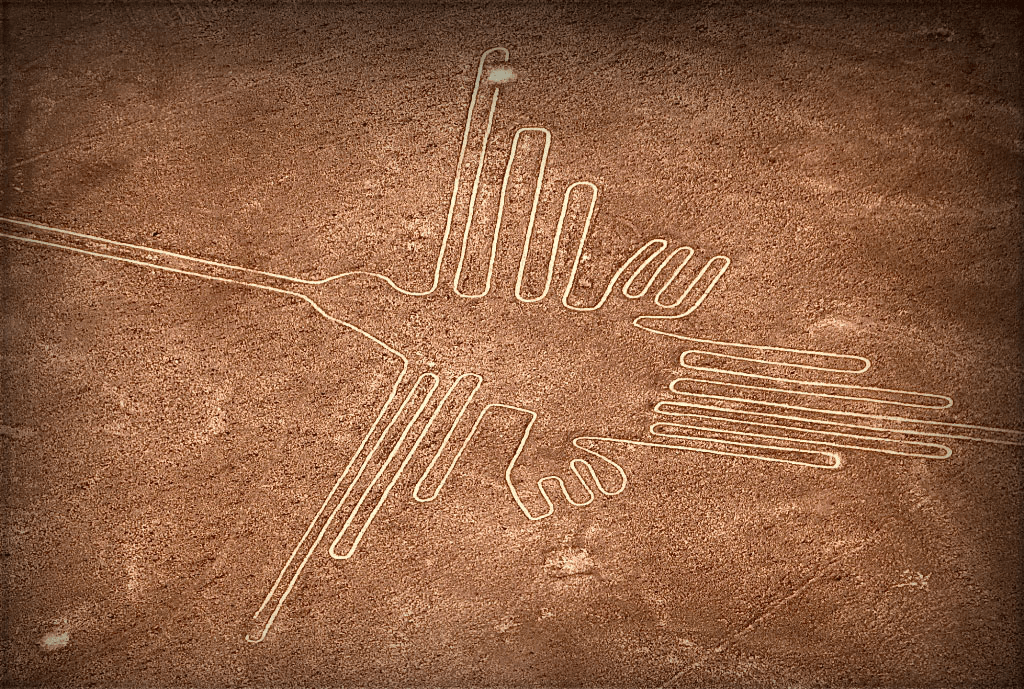
It is one of the most iconic and memorable figures of the Nazca Lines, known for its harmonious proportions. The distance between its two wings is approximately 66 meters.
Discovery
The Hummingbird has long been considered one of the most representative depictions of this heritage. Its discovery and subsequent study suggest that it served religious purposes and was tied to cults practiced by the ancient Nazca inhabitants.ado a lo largo de los años como una de las representaciones más icónicas de este patrimonio. Su descubrimiento y posterior estudio sugieren que cumplía funciones vinculadas a actividades religiosas y cultos practicados por los antiguos pobladores de Nazca.
Some Theories and Mysteries
According to historian María Rostworowski, these figures were designed to be seen from the sky. However, their purpose was not the study of the stars, but to pay tribute to a flying god, revered and feared by the Nazca communities. Thus, the Hummingbird may have served as a symbolic offering to avoid divine wrath in the form of droughts, a constant threat in a land as arid as Nazca.

The Monkey
What is it?
The curiosity of this figure lies in the fact that it depicts a monkey with nine fingers and a spiral-shaped tail. It is believed to represent the constellation of the Big Dipper. This figure is considered one of the most significant of the Nazca Lines, with an approximate size of 135 meters.
Discovery
The discovery of these lines by German researcher Maria Reiche marked the beginning of a series of theories suggesting a possible astronomical origin for the Lines. It is believed that the ancient inhabitants of Nazca used this gigantic geoglyph as a starting point to study the sky and anticipate astronomical events that could affect their agriculture and survival.
Some Theories and Mysteries
According to the researcher, the group of constellations in the sky has a direct relationship with the formation of the monkey’s tail and hands in the geoglyph. The appearance of these stars in the sky would be directly related to the arrival of the rainy seasons, which were crucial for such an arid region like Nazca.

The Frigate Bird
What is it?
With an approximate length of 160 meters, the most distinctive feature of this figure is its head, which is formed by segments of circles with radii ranging from 10 to 20 centimeters. In profile, two circles of equal size could represent its eyes.
Discovery
As Maria Reiche mentioned at the time of its discovery, the vastness of this figure lies in the fact that, if you stand at the tip of one of its wings, you cannot see the other side. This figure is approximately equivalent to the size of 6 football fields.
Some Theories and Mysteries
The creation of this geoglyph is linked to astronomy, as its alignment corresponds to a configuration of the night sky. Although it is not aligned with sunsets or the moon, it is aligned with Fomalhaut, a very bright star located in the constellation of Pisces.

The Spider
What is it?
Part of an extensive network of lines located on the edge of a trapezoid on the Earth’s surface, the Spider is another of the most notable figures due to the skill with which it was traced. It measures approximately 46 meters in length.
Discovery
The skill with which this figure was created not only represents an impressive act of art, but since its discovery, it has been linked to the constellation of Orion, which is globally recognized for being one of the brightest in outer space.
Some Theories and Mysteries
This geoglyph has both astronomical and religious aspects. Both are related to making omens about the rainy season. In this way, being in such an arid place, the inhabitants and scholars used this figure to predict and avoid periods of drought.