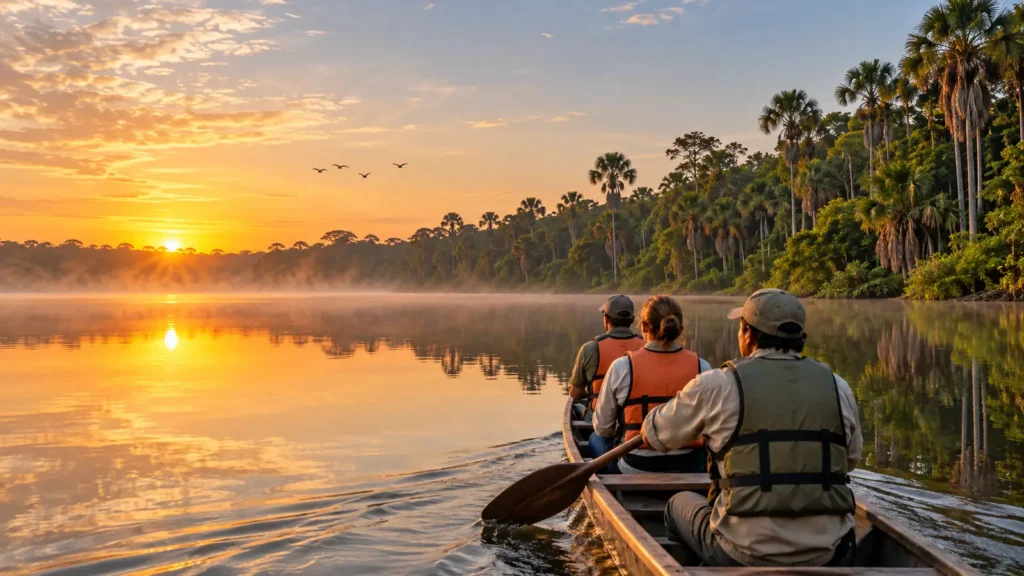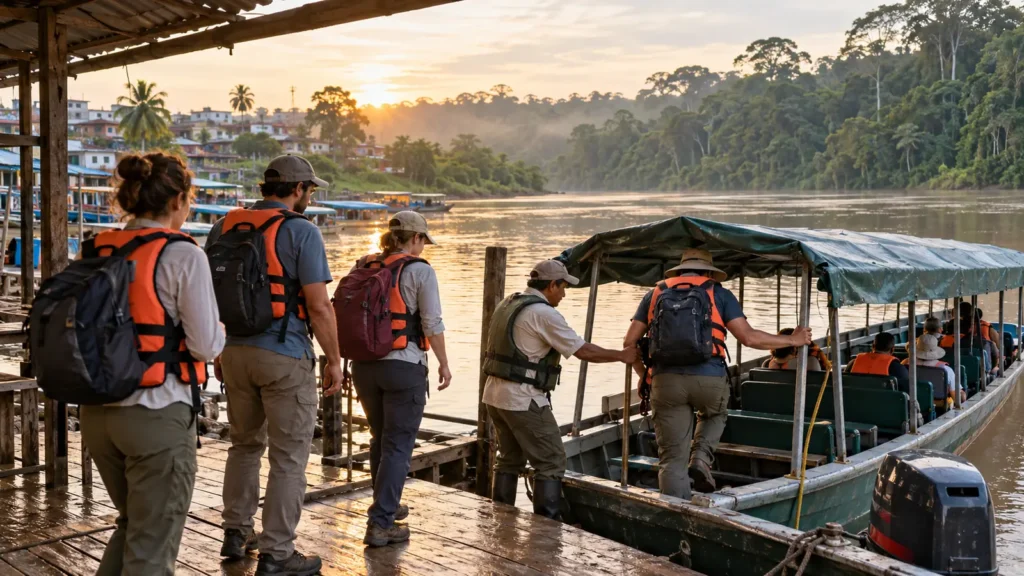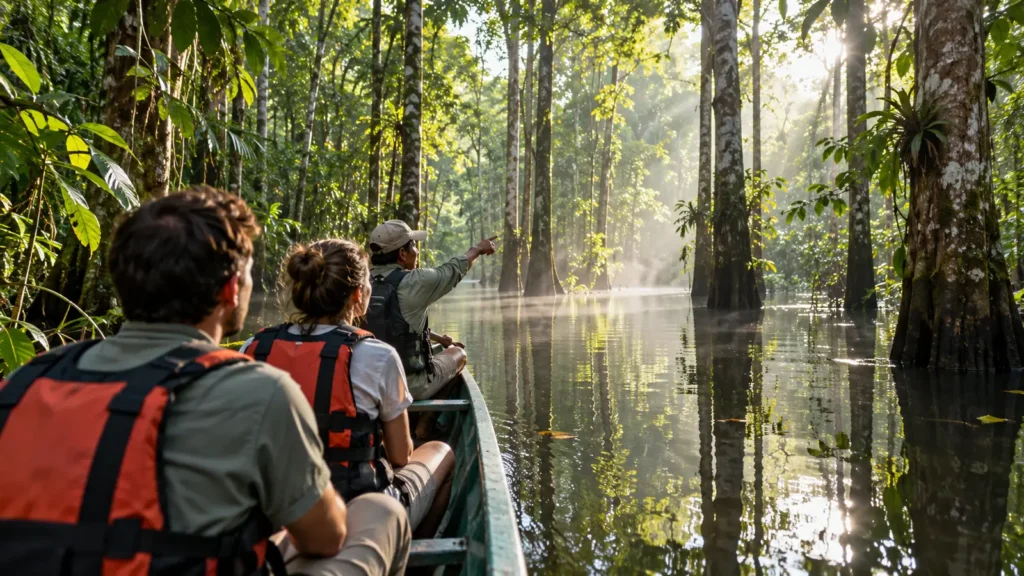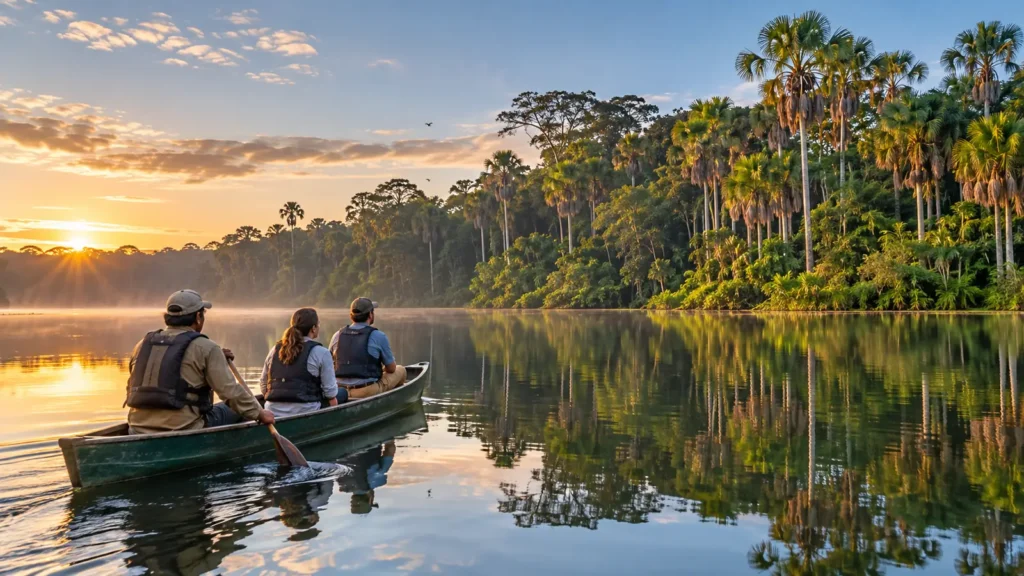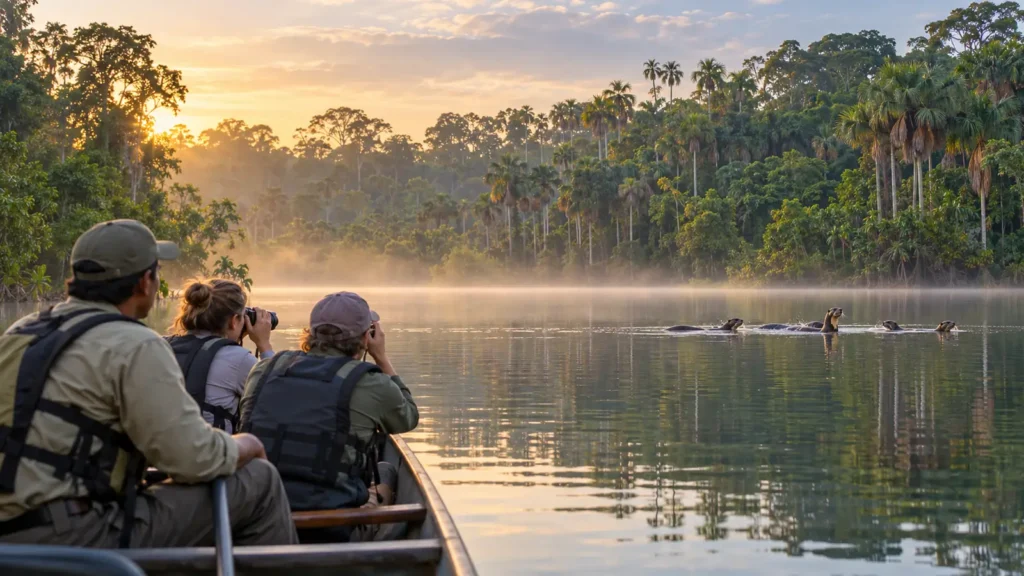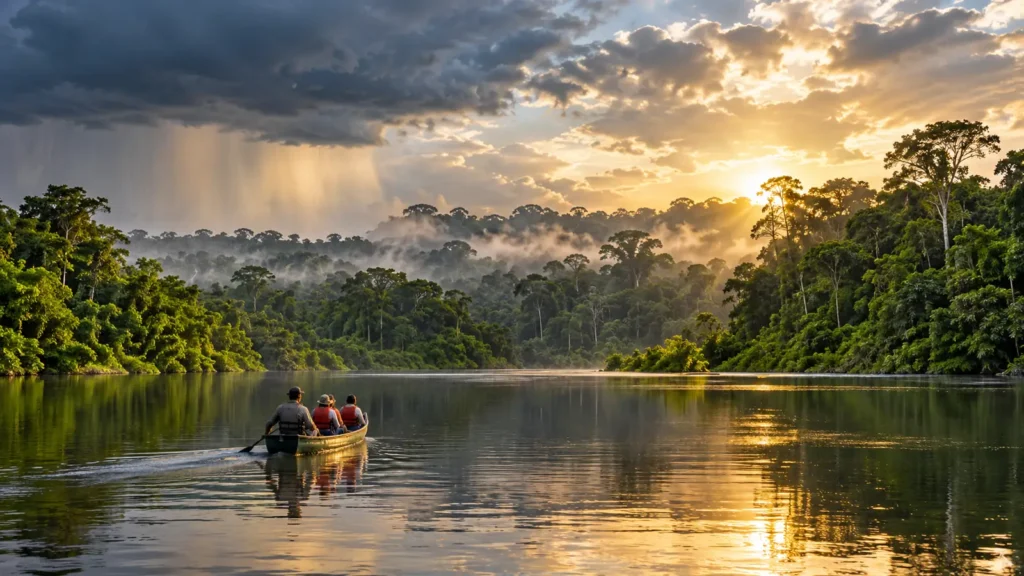
The best time to visit the Iquitos Amazon depends on whether you prefer canoe access through flooded forest or longer walks along exposed banks. Rain falls throughout the year, and river level does not change immediately with each storm. Higher water usually expands navigation into forest channels; lower water exposes beaches and increases terrestrial trail options. Wildlife remains present in both periods, but the habitats and viewing angles change.
Iquitos has seasons, but not four traditional seasons
Iquitos is hot, humid and rainy year-round. It does not have a cold winter or a reliably rain-free summer. Travel planning is more useful when divided into higher-water, falling-water, lower-water and rising-water phases. These overlap with wetter and relatively drier periods but are not identical.
Rain near the lodge is only part of the system. Water moving through the vast upper Amazon basin influences local rivers later. A sunny week does not instantly create low water, and one downpour does not produce the season’s peak. The Iquitos Amazon travel guide explains how this cycle affects lodges, tributaries and Pacaya Samiria.
High water vs low water at a glance
| Travel factor | Higher water | Lower water |
|---|---|---|
| Main experience | Canoeing among flooded trees and reaching water-only channels | Beaches, exposed banks and longer terrestrial walks |
| Forest perspective | Boat sits closer to mid-level branches and canopy activity | More observation from trails, banks and open river edges |
| Walking | Some trails may be flooded or shortened | More ground can be accessible, although mud remains possible |
| Boat access | Small channels may open | Shallow channels may close or require route changes |
| Weather | Often wetter, with frequent showers and storms | Relatively drier, but rain and humidity continue |
| Best for | Flooded-forest scenery and canoe-focused travelers | Hikers, beaches and riverbank wildlife observation |
Higher-water season: what to expect

During higher water, rivers spread into floodplain forest and connect channels that may be inaccessible later. Guides can paddle among trunks and beneath branches, offering an unusual view into the forest. This is one of the defining northern Amazon experiences.
Some ground trails disappear beneath water, so itineraries rely more heavily on boats. Dock height, current and landing points can change. Travelers should be comfortable entering a canoe, sitting for longer periods and wearing a flotation device. Waterproof storage becomes essential.
Higher water does not mean nonstop rain. Tropical showers can be intense and brief, followed by bright conditions. It also does not mean every forest is navigable; access varies with the river, tributary and lodge.
Lower-water season: what to expect

As water recedes, sandbars, beaches and muddy or sandy banks emerge. Forest walks can become longer, and animals may concentrate around remaining channels or exposed feeding areas. Waterbirds often use open banks, while river transport may follow deeper channels.
Some small creeks become too shallow for boats, so a promised canoe route may be replaced by a walk or different river outing. Strong sun can reflect from exposed sand and water, increasing the need for a hat, sunscreen and drinking water.
Lower water is not “dry” in an everyday sense. Humidity remains high and sudden rain can still affect trails, flights and river travel.
A practical month-by-month framework
These ranges are tendencies, not guarantees. River peaks and lows shift between years and locations.
| Period | Likely pattern | Planning emphasis |
|---|---|---|
| January–March | Wet conditions and generally rising or high water | Flooded-forest access, strong rain protection |
| April–May | Often high water, then gradual transition | Canoe routes may remain open even as rainfall shifts |
| June–August | Falling water and relatively drier conditions | Mixed boat and trail possibilities; popular travel period |
| September–October | Often lower water, with rain beginning to rebuild | Exposed banks and walks; shallow routes may change |
| November–December | Rising-water transition and increasing rain | Flexible itinerary as channels and trails change |
The dedicated Iquitos high-water versus low-water guide will compare these phases in greater detail. For Peru-wide context, consult the best time to visit the Peruvian Amazon.
Why transition months can be a strong choice
A transition period may combine features of both major phases. Water can remain high enough for some flooded-forest channels while rainfall begins to ease, or exposed banks may still be visible as rains return. This variety is attractive, but it makes a fixed online itinerary less reliable.
Ask the lodge which channel, lake and trail were operating during the previous week—not only what normally happens in that month. Guides may choose different routes each morning according to depth, current and recent rain. Travelers who value one non-negotiable activity should obtain current guidance shortly before final payment and retain alternatives.
Transition timing also differs between the main Amazon River, smaller tributaries and protected-area basins. A report from central Iquitos cannot describe every lodge. Local operational knowledge is more useful than a generic river chart when deciding whether a canoe can reach a particular forest.
Best timing for different travelers
First-time Amazon visitors
Choose dates that fit the wider Peru route and stay at least four days if possible. Either water phase can be rewarding when the lodge visits more than one habitat and offers safe alternatives.
Hikers and active travelers
Favor falling or lower water for a greater chance of extended trails and exposed banks. Confirm walking distance and surface because mud, heat and humidity remain in every month.
Canoe-focused travelers
Favor higher water when flooded forest is the priority. Ask whether the itinerary uses paddle canoes, small motorboats or both, and how long guests normally remain seated.
Families
Select the lodge and transfer before the season. Shorter boat journeys, flexible activity length, child-sized flotation equipment and screened rooms usually matter more than a small difference in monthly rainfall.
Birders and photographers
Lower water may expose productive banks, while higher water can improve access to canopy-level forest. Prioritize a private or small-group guide, stable boat, early starts, charging access and waterproof equipment protection. Add days so one storm does not eliminate the main photography window.
Travelers combining Iquitos with other regions
Coordinate Amazon dates with fixed reservations such as Machu Picchu entry and with live flight schedules. A theoretically ideal river month is a poor choice if it forces a risky same-day connection or leaves too little lodge time.
How rain affects a lodge itinerary

Rain normally changes timing rather than canceling an entire trip. A guide may delay departure, choose a sheltered waterway, replace a slippery trail or move an activity to late afternoon. Heavy storms, lightning, current or poor visibility can justify a larger change.
A good lodge builds alternatives into the program. Ask what happens when the planned tributary, forest trail or night walk is unsafe. Avoid a package whose value depends on one weather-sensitive outing.
Keep rain gear accessible rather than packed at the bottom of the suitcase. Use a dry bag or waterproof pouch for passports, phones, camera batteries and medicine. Never stand in an exposed boat during a storm to protect equipment.
Wildlife by season

There is no wildlife-free season. The viewing context changes. Higher water can bring boats closer to canopy branches and allow access to flooded habitat. Lower water exposes banks used by birds, reptiles and mammals and can concentrate aquatic life in remaining channels.
Pink and gray river dolphins may be encountered in suitable waterways throughout the year, but surface time and distance vary. Monkeys, sloths, caimans and birds remain wild and cannot be scheduled. Flowering, fruiting, nesting and river conditions influence daily patterns.
The Peruvian Amazon wildlife guide explains why habitat and patient observation matter more than a species guarantee. Choose a skilled guide, small group and sufficient days rather than booking from a promotional animal collage.
Pacaya Samiria seasonality
Pacaya Samiria’s official visitor information identifies May through September as the recommended visiting period and October through April as the rainy season. That guidance reflects access and overall visitor conditions, but it does not make other months impossible. Authorized operators adapt routes to the selected basin and water level.
Higher water expands navigation through the reserve’s floodplain forest. Receding water can expose banks and produce different bird and aquatic observation. Some sensitive beaches require extra distance during nesting periods, and ranger instructions always take priority.
Because reserve basins differ, ask for the exact checkpoint and route. A general “Pacaya Samiria” label is not enough to predict water conditions or transfer time.
Heat, humidity and mosquitoes
Expect warm temperatures and high humidity in every month. Sun can feel intense during open-river travel even on a cloudy day. Hydrate regularly, use sun protection and pace forest walks.
Mosquito and biting-insect pressure varies by water, vegetation, hour and local weather, not only by season. Wear light-colored long clothing when practical and apply repellent according to its instructions. Discuss vaccines and mosquito-borne disease prevention with a qualified travel-health professional for your personal route.
Crowds, availability and prices
Relatively drier months often overlap with international holiday periods and Peru’s busiest travel season. Flights, popular lodges and preferred room types can fill earlier. Rainier months may feel quieter, but a lower headline price is not valuable if the lodge or route does not match your desired activities.
Request a date-specific quote and compare transfers, meals, guide ratio, room type and cancellation conditions. The Peruvian Amazon trip cost guide provides a complete budgeting method.
Choose the best time by activity
- Flooded-forest canoeing: favor higher water, but confirm the lodge’s actual channels.
- Long forest walks: favor lower-water months while accepting mud and rain remain possible.
- River beaches and exposed banks: favor lower water.
- General wildlife and first visit: travel when your schedule allows and choose a strong guide and enough nights.
- Pacaya Samiria: match the season to the exact basin and route with an authorized operator.
- Photography: consider water perspective, group size, boat stability and protection for equipment.
How many days help with weather?
Three days usually mean two nights and one full lodge day. A storm during the only complete day can have an outsized effect. Four or five days provide more dawns, evenings and opportunities to rearrange activities.
Review the three-day Iquitos and Tambopata itinerary options and the guide to how many days to spend in the Amazon. Remote Pacaya Samiria routes deserve longer because access itself consumes substantial time.
What to pack in every season

Bring quick-drying long sleeves and trousers, a breathable rain shell or poncho, closed walking shoes, lodge sandals, hat, sunscreen, insect repellent, headlamp, refillable bottle, binoculars and waterproof storage. Pack spare socks and protect batteries from humidity.
For higher water, prioritize a reliable dry bag and clothing comfortable for longer canoe outings. For lower water, add strong sun protection and footwear suited to sandy or muddy banks. The Peruvian Amazon packing list gives a complete checklist.
Build a weather-flexible itinerary
- Choose the experience—flooded forest or more walking—before choosing a month.
- Ask the lodge which routes normally operate during your dates.
- Book enough nights to create alternative observation windows.
- Keep flights and boat transfers separated by realistic margins.
- Pack for rain, sun and humidity regardless of season.
- Accept safe substitutions when the guide responds to current conditions.
The guide on how to get to Iquitos and reach a jungle lodge will cover flight and boat coordination. For immediate safety planning, read is the Peruvian Amazon safe?
Current Explora el Peru Iquitos tour
The Amazonas Sinchicuy Lodge three-day tour currently operates from Iquitos with two lodge nights, river transfers, meals, guiding and programmed excursions. The live page notes that some activities depend on season and conditions. Confirm arrival timing, water-sensitive routes and the final schedule for your date.
Frequently asked questions
What is the driest month in Iquitos?
Monthly averages do not create a rain-free guarantee. Relatively drier conditions are common in the middle of the year, but tropical showers remain possible. Choose by water-level experience rather than one “driest” month.
When is the Amazon River highest near Iquitos?
Water is generally higher after the wetter part of the annual cycle, often around the first half of the year, but the timing and peak vary. Ask for the current local level.
Is rainy season a bad time to visit?
No. It can provide excellent flooded-forest access and dramatic scenery. It requires flexible plans, strong rain protection and acceptance that some trails may be unavailable.
Are there fewer mosquitoes in low-water season?
Insect pressure can change, but it remains location- and weather-dependent. Use protection in every season rather than relying on a monthly assumption.
Which season is better for dolphins?
Dolphins can occur year-round. Water level changes where they feed and how boats can access channels, but no season guarantees a sighting.
Can weather cancel my lodge transfer?
Severe storms or unsafe navigation can delay or alter travel. Ask the operator about contingency plans and leave a buffer before the next flight.
Is May to September always best for Pacaya Samiria?
SERNANP lists it as the recommended period, but the best dates depend on the exact basin, desired activity and current conditions. Other months offer different water-based experiences.
Editorial sources
Season and access context for the reserve was checked against the official SERNANP Pacaya Samiria visitor page. Current regional outlooks can be checked through SENAMHI Loreto. Tour inclusions were checked against Explora el Peru’s live Sinchicuy Lodge page. River level, rain, routes and wildlife activity vary; confirm local conditions for the actual travel dates.