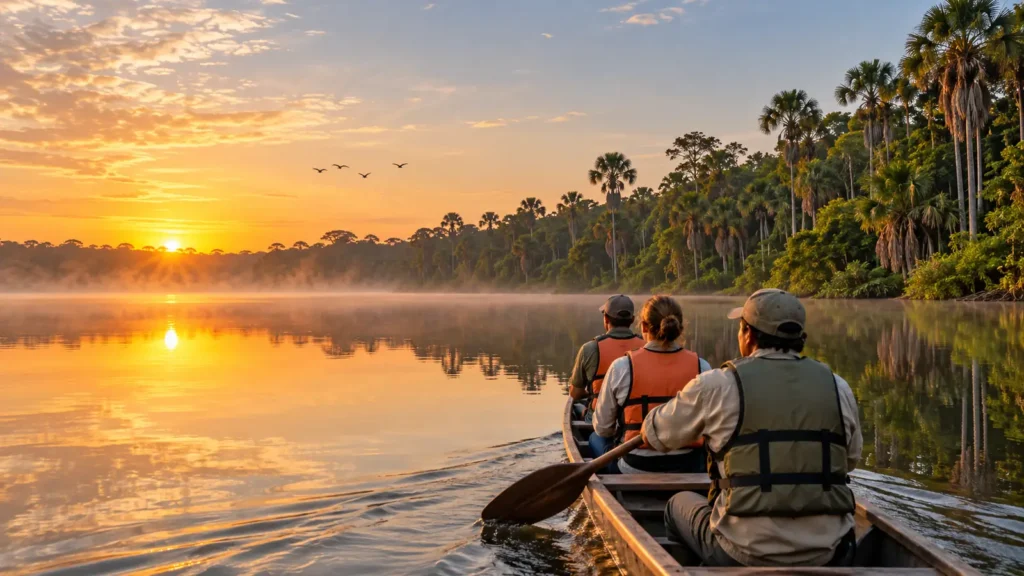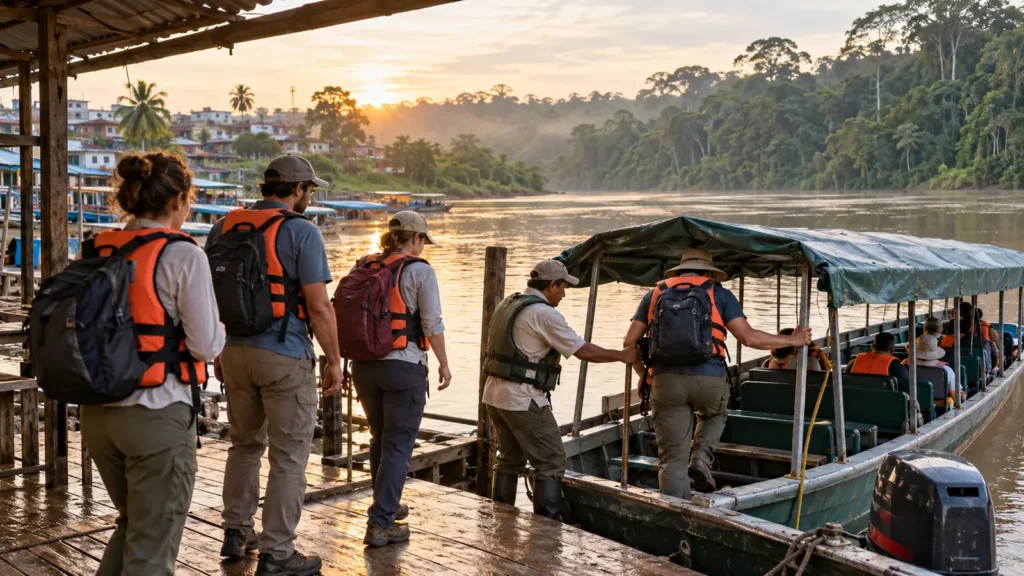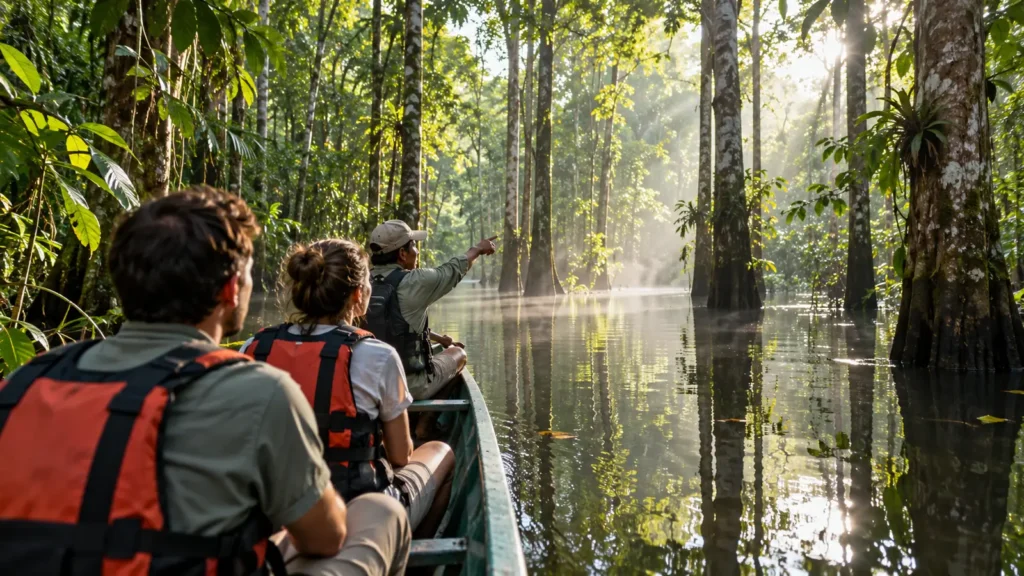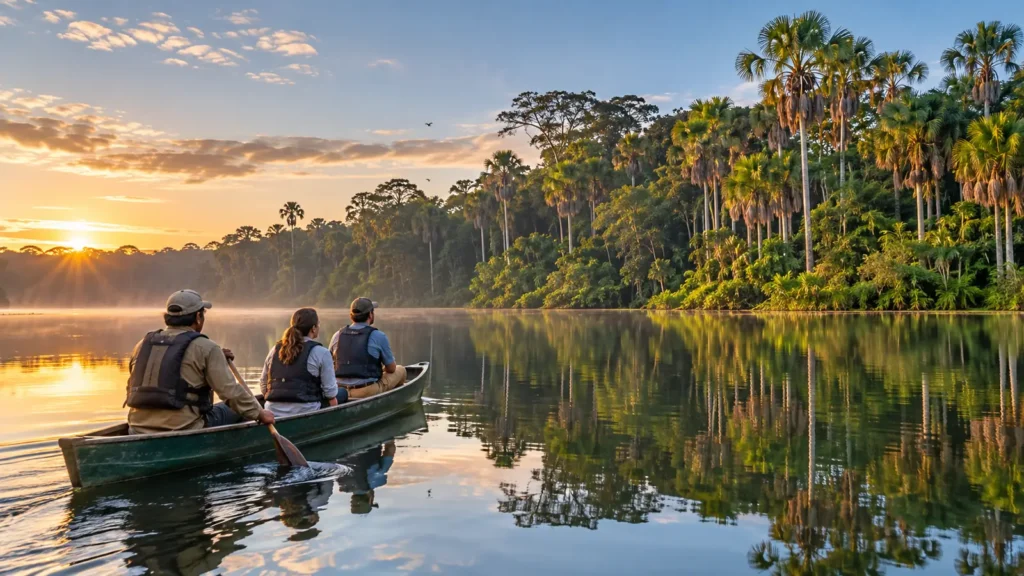

Peruvian Amazon wildlife ranges from highly visible macaws, monkeys and caimans to elusive jaguars, tapirs and harpy eagles. A good lodge itinerary can produce many rewarding observations, but the rainforest is not a zoo: sightings depend on habitat, water level, season, time of day, guide skill and luck. The best trip is built around varied habitats and realistic expectations rather than a checklist of guaranteed animals.
What animals live in the Peruvian Amazon?
The Peruvian Amazon rainforest is not one uniform landscape. It contains firm-ground forest, seasonally flooded forest, rivers, streams, palm swamps, oxbow lakes, riverbanks and forest canopy. Each habitat favors a different set of animals, so a boat excursion at dawn reveals a different world from a night walk through the understory.
| Wildlife group | Examples travelers may encounter | Productive setting |
|---|---|---|
| Primates | Capuchins, squirrel monkeys, tamarins, howler monkeys | Canopy edges, fruiting trees and quiet forest trails |
| Aquatic mammals | Giant river otters, pink and gray river dolphins | Oxbow lakes, rivers and flooded channels |
| Birds | Macaws, parrots, toucans, hoatzins, herons, kingfishers | Clay licks, lakeshores, canopy and open river corridors |
| Reptiles and amphibians | Caimans, turtles, lizards, tree frogs and snakes | Lake margins, sunlit logs and night walks |
| Large forest mammals | Tapirs, capybaras, peccaries and big cats | Mineral licks, riverbanks and quieter interior forest |
SERNANP reports 600 bird species, 169 mammal species, 103 amphibian species and 103 reptile species in Tambopata National Reserve. Those totals describe regional biodiversity, not what one visitor should expect to see during a short stay.
Wildlife changes with the habitat
Terra firme forest sits above the normal flood level. Its tall, layered vegetation supports canopy primates, toucans, woodpeckers and countless smaller organisms, while tapirs, peccaries and cats move more discreetly below. Visibility can be limited, so guides rely on alarm calls, tracks, fruit remains and movement in the canopy. The experience is less about seeing across long distances and more about reading a living three-dimensional forest.
Flooded forest and blackwater channels become especially important in the Iquitos region. Water can carry visitors between tree trunks when levels are high, creating opportunities for quiet boat observation. Fish move into flooded areas to feed, and birds, monkeys, reptiles and dolphins use the connected aquatic landscape. At lower water, access and animal distribution change; exposed banks and concentrated channels create different opportunities.
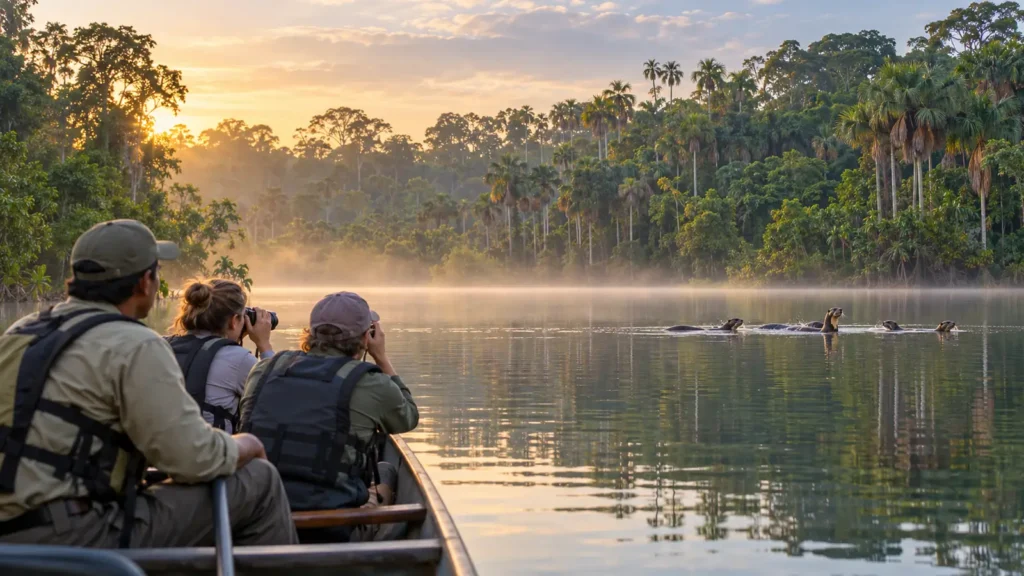
Oxbow lakes are former river bends separated from the main channel. Calm water, fish populations and shoreline vegetation can support giant river otters, caimans, hoatzins, kingfishers, turtles and monkeys feeding near the edge. Because sound travels across open water, paddling slowly and limiting conversation helps both observation and photography.
Riverbanks and clay licks create open sightlines that are rare inside dense forest. Capybaras, herons, kingfishers and reptiles may use river margins, while mineral licks attract specific birds or mammals under suitable conditions. Visitors should remain at designated viewpoints because approaching the bank can interrupt the very behavior they traveled to observe.
Canopy platforms and towers shift the observer into the level used by many birds and arboreal mammals. Distant views make binoculars essential. Towers are also useful for understanding the scale of the forest: an animal that seems absent from the trail may simply be active tens of meters overhead.
Monkeys and other canopy mammals
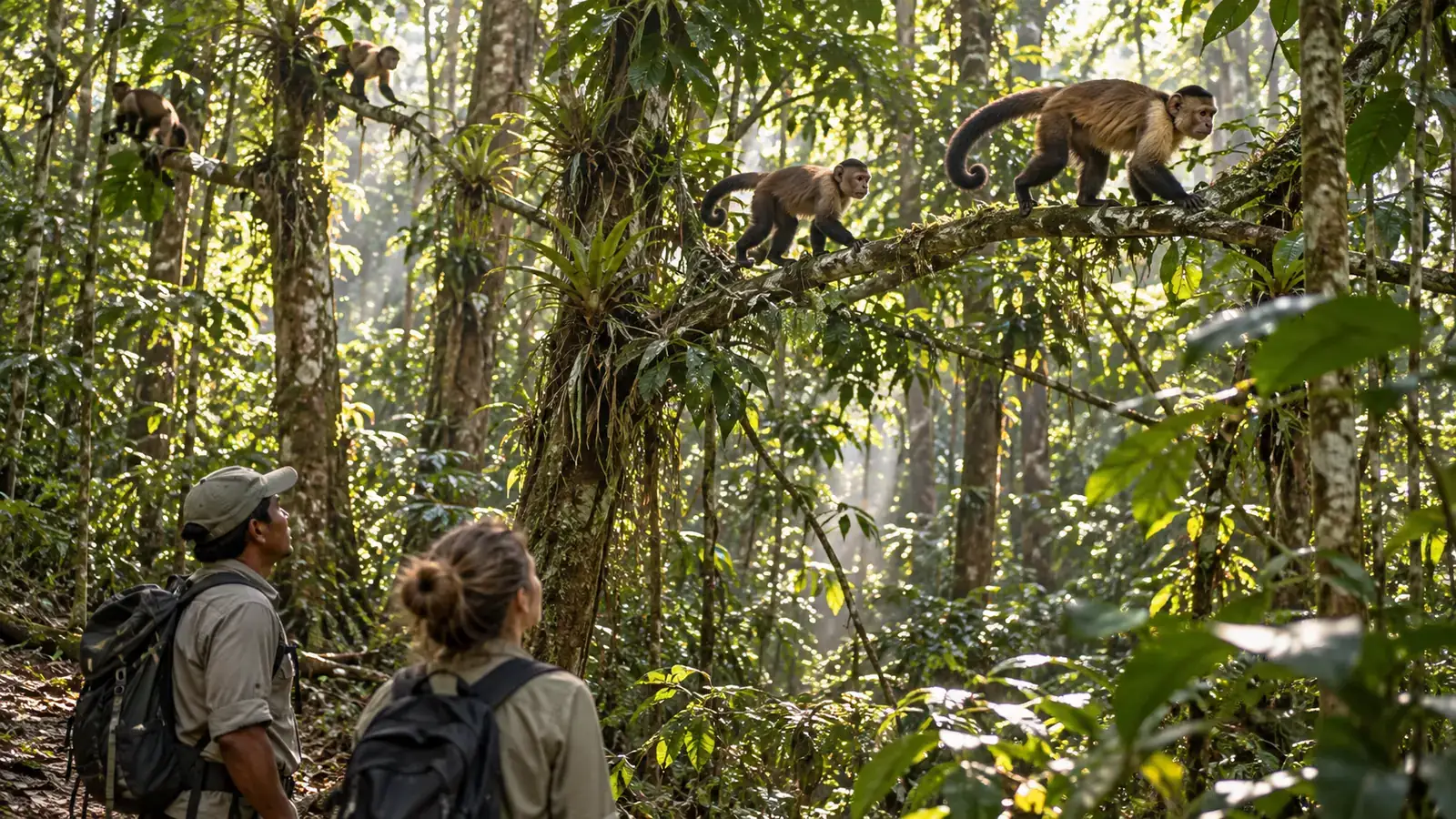
Monkeys are among the most engaging daytime sightings because their calls, falling leaves and moving branches often reveal them before their bodies become visible. Different species use different canopy levels. Small tamarins and squirrel monkeys can move quickly through tangled edges, while capuchins examine branches methodically for fruit and invertebrates. Howler monkeys are frequently detected by their far-carrying calls.
Sloths may occur around both northern and southern destinations, but their camouflage makes them easy to overlook. A guide can recognize the rounded shape, feeding signs or unusual texture that separates a sloth from a cluster of leaves. Binoculars are more useful than approaching the animal, and quiet observation often allows natural behavior to continue.
Primates should never be fed or encouraged toward visitors. Food changes their behavior, creates conflict and can expose wildlife and people to disease. Semi-captive or habituated encounters should be described honestly; they are not equivalent to finding an animal moving freely through intact forest.
Giant river otters, dolphins and life on the water
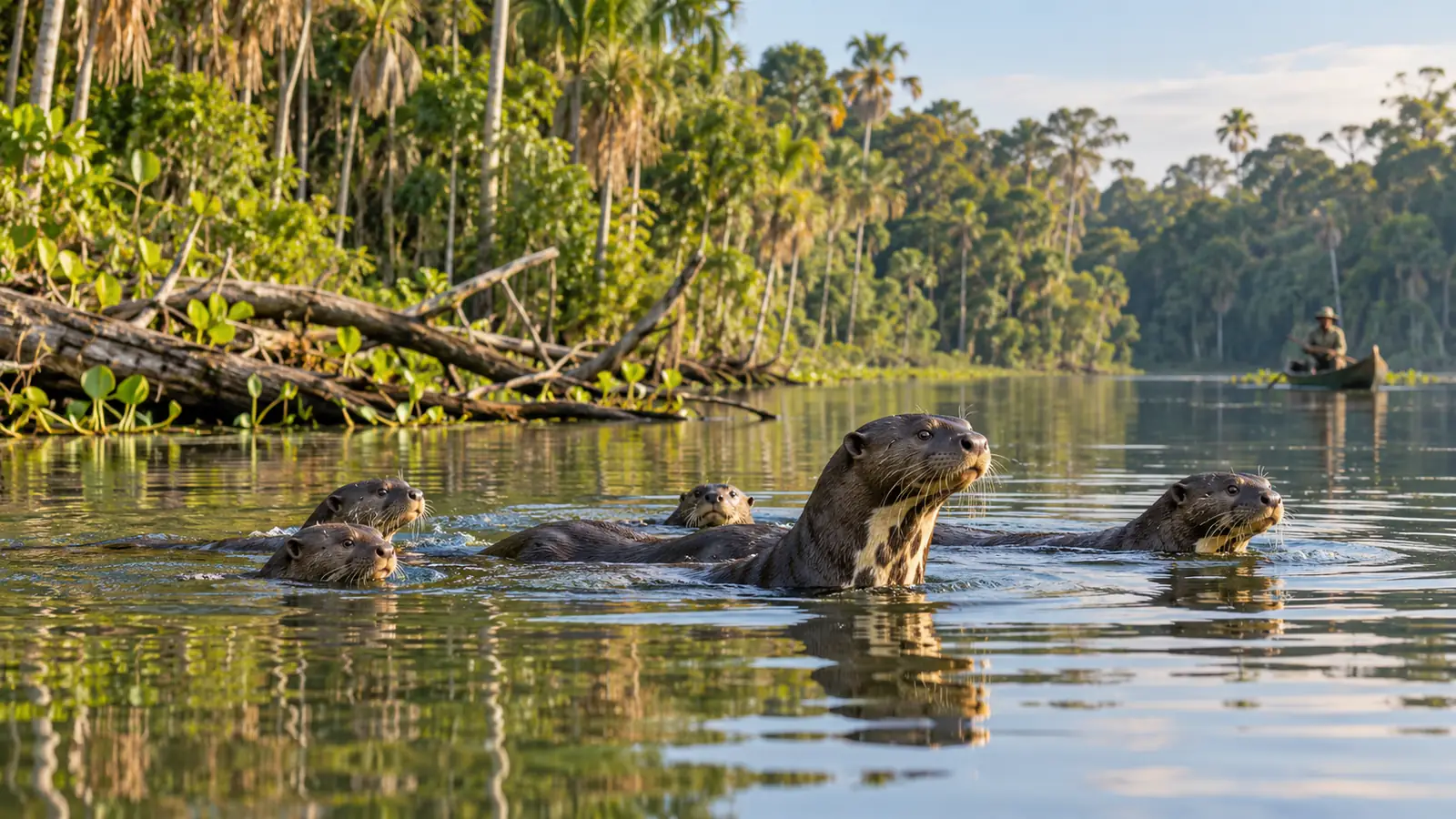
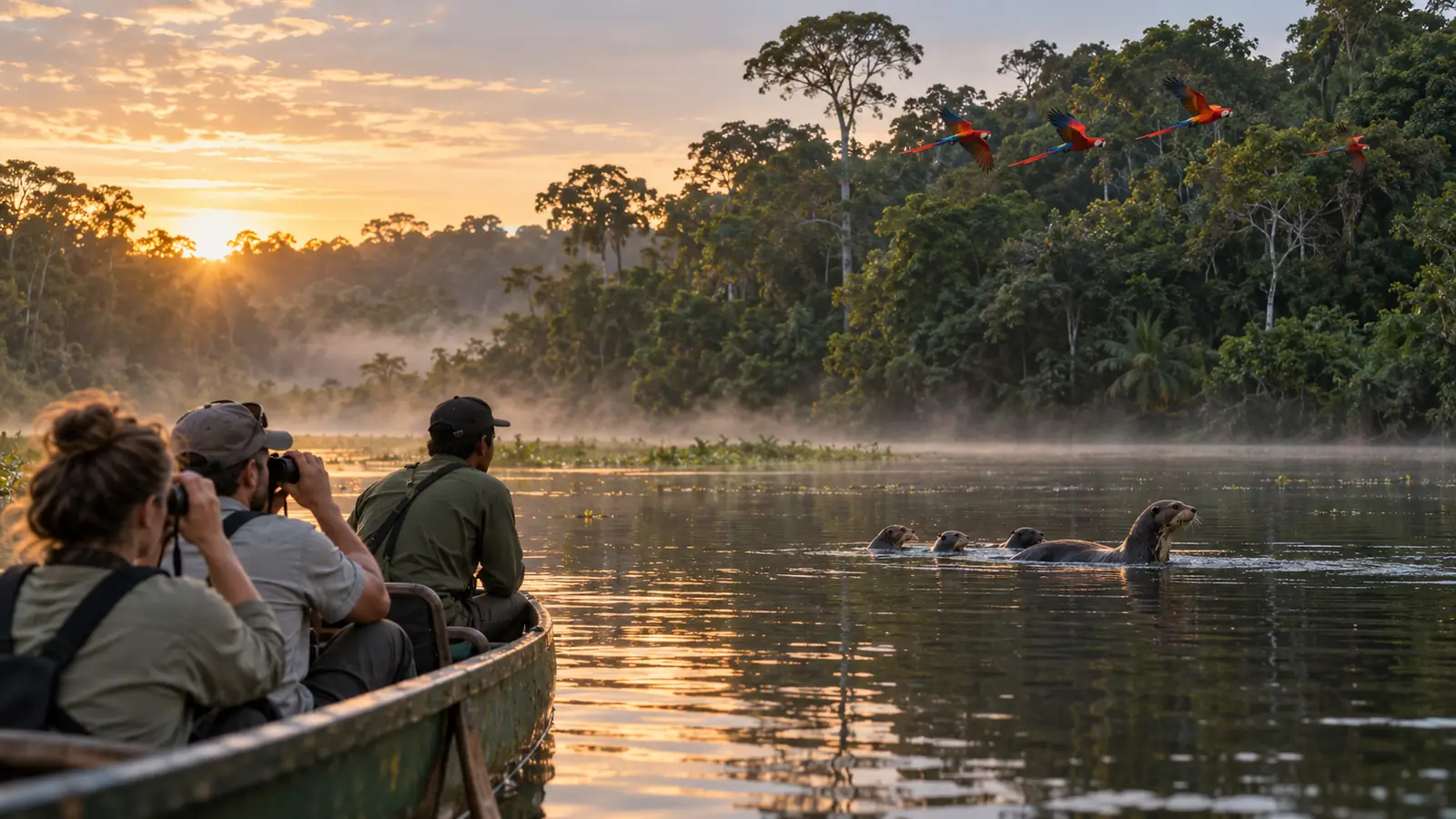
Giant river otters live in family groups and are a signature species of protected lakes in southern Amazonian Peru. Their calls, coordinated swimming and fishing behavior make a distant encounter memorable. SERNANP identifies permanent otter groups in lakes within Tambopata, including sectors where visitors may observe morning activity from approved routes. An encounter is never certain, and guides should avoid blocking an otter family’s direction of travel.
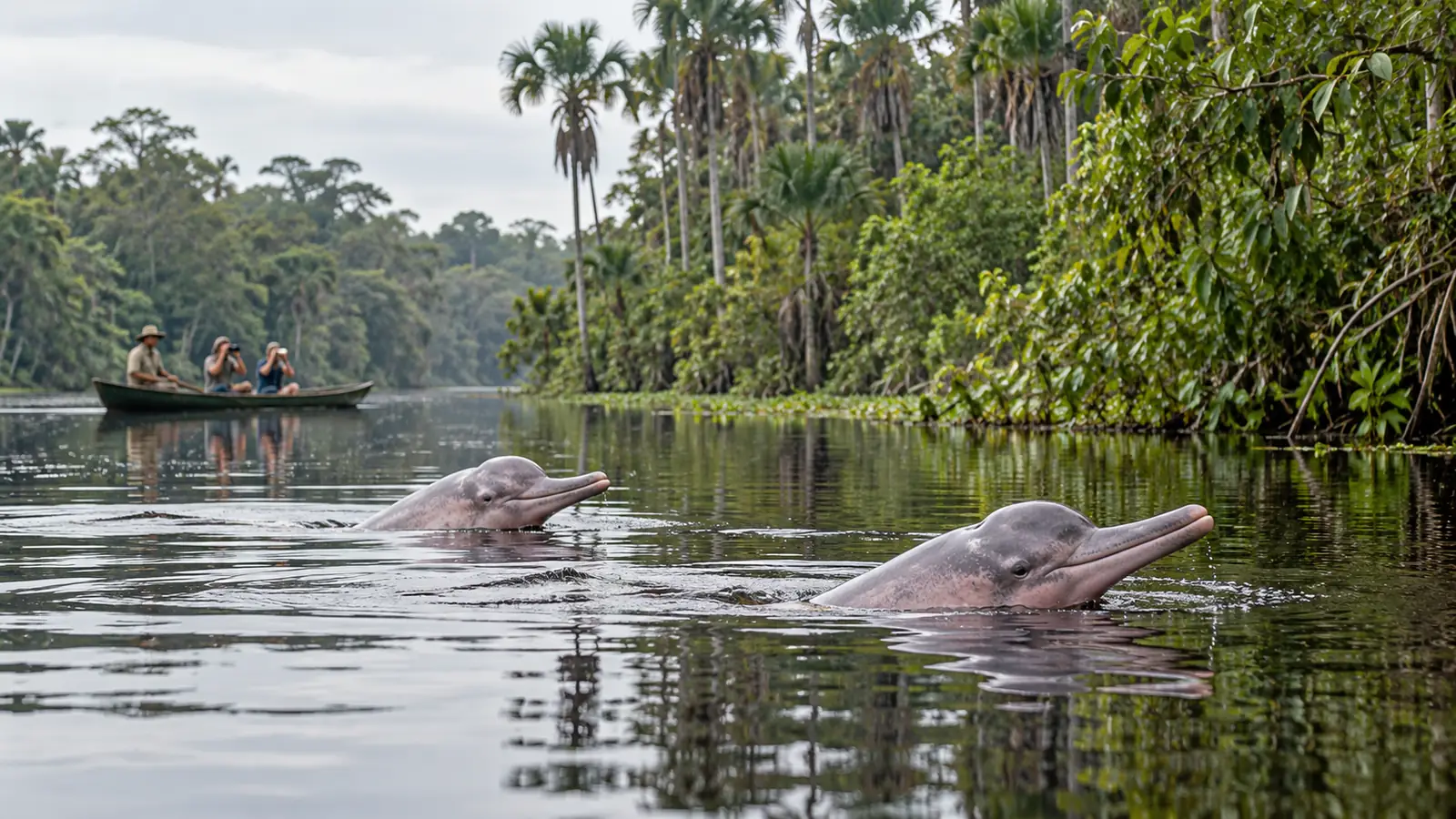
In the north, the waterways associated with Iquitos and Pacaya Samiria offer a different aquatic focus. Pink river dolphins and gray river dolphins surface briefly, often without the dramatic leaps associated with marine dolphins. SERNANP lists pink dolphins, black caimans, taricaya turtles and large groups of waterbirds among the characteristic wildlife of Pacaya Samiria’s flooded-forest routes.
Caimans are often found by scanning shorelines and channels, particularly around dusk or after dark. Capybaras, turtles, kingfishers and herons may also appear along river margins. A slow boat with an experienced driver generally creates better observation conditions than a rushed approach.
Macaws, toucans and rainforest birdlife

Birds provide the greatest variety of visible Amazon wildlife. Macaws and parrots cross open skies in pairs or groups, toucans move between fruiting trees, and kingfishers work the edges of rivers and lakes. Hoatzins are associated with waterside vegetation, while herons and cormorants are especially noticeable in aquatic habitats.
Tambopata is known for mineral-rich clay banks where parrots and macaws may gather. SERNANP describes the Chuncho and Colorado clay licks as observation routes where visitors use hides or established viewpoints. Activity is influenced by weather and local conditions; a famous clay lick is still a natural site, not a scheduled performance.
For birdwatching, the first hours after sunrise are usually valuable because the forest is cooler and many species are vocal. Learning calls with a local guide matters as much as eyesight. A bird heard but not seen is still useful evidence: the call helps the group wait in the correct place rather than walking past.
Night wildlife: frogs, insects and reptiles
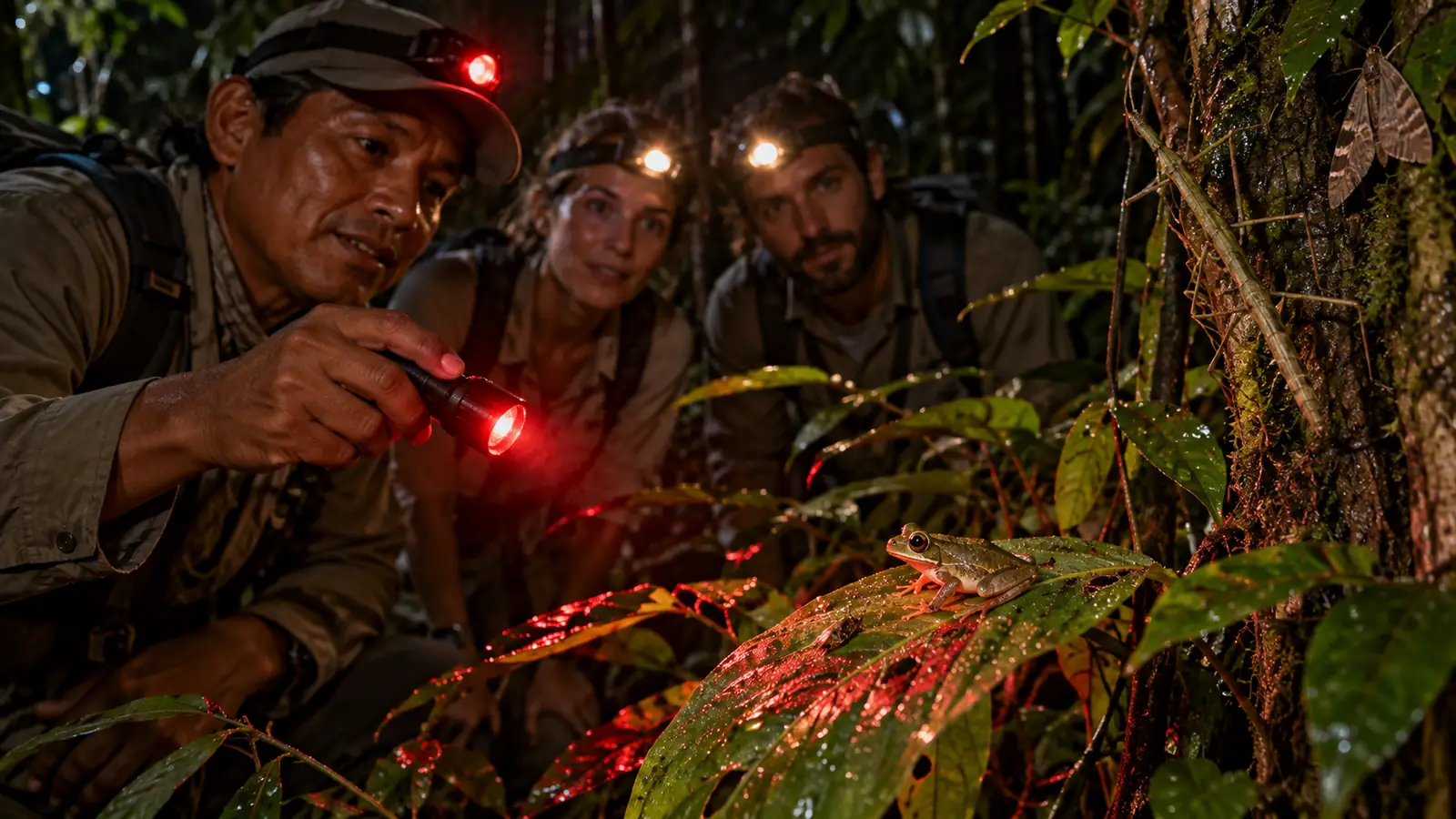
A night walk reveals animals hidden during daylight. Tree frogs call near temporary pools, stick insects disappear against branches, moths settle on leaves and tarantulas may wait near retreats. Small lizards, sleeping birds and snakes are possible, although none should be handled or moved for a photograph.
Stay behind the guide, use controlled light and watch where hands and feet are placed. Flash should be limited, especially with sensitive nocturnal animals. The objective is to observe behavior without surrounding, touching or repeatedly dazzling the subject. Consult the practical Peruvian Amazon safety guide before traveling and use the Amazon packing list for footwear, headlamp and rain protection.
Jaguars, tapirs and other rare sightings
Jaguars, ocelots, tapirs, anacondas and harpy eagles belong to the Amazon ecosystem, but short lodge trips rarely produce dependable sightings. Many are naturally scarce, nocturnal, wide-ranging or exceptionally well camouflaged. Tracks, calls, feathers, feeding remains and camera-trap photographs can be more realistic evidence than a direct view.
A responsible operator does not promise a jaguar. It explains the habitat, reads signs with guests and treats an unexpected encounter as a privilege. Travelers who judge a trip only by its rarest animal may miss mixed monkey groups, leafcutter ants, nesting birds and the ecological relationships unfolding at eye level.
Iquitos or Tambopata for wildlife?
The detailed Iquitos or Tambopata comparison covers logistics and landscapes. From a wildlife perspective, the strongest choice depends on the habitats and species that interest you.
| Destination | Wildlife character | Good fit for |
|---|---|---|
| Iquitos and Loreto | Large river systems, flooded forest, river dolphins, monkeys and waterbirds | Boat-based exploration and northern floodplain ecology |
| Puerto Maldonado and Tambopata | Accessible oxbow lakes, macaw clay licks, giant river otters, monkeys and canopy wildlife | A mix of trails, lakes, river excursions and observation towers |
The Iquitos Amazon travel guide and forthcoming Tambopata travel guide examine each region in depth. Travelers especially interested in southern species and habitats can also use the dedicated Tambopata wildlife guide.
How season and water level affect sightings
There is no month when every animal becomes easy to see. The best time to visit the Peruvian Amazon depends on whether you prioritize trail conditions, boat access, river levels or a particular habitat. Rain can reduce visibility during an excursion, yet it can also activate frogs and freshen forest activity.
Near Iquitos, higher water opens flooded channels to small boats and changes where animals feed or rest. Lower water exposes banks and beaches and can concentrate some aquatic observations. In Tambopata, drier periods may make trails easier, but rain remains possible throughout the year. Wildlife follows food, nesting cycles, river conditions and disturbance, not a tourist calendar.
How to improve your chances of seeing animals
- Choose habitat variety. Combine forest trails, an oxbow lake, river travel, canopy observation and a night walk rather than repeating one environment.
- Go out early and stay patient. Dawn and late afternoon are productive, while slower observation often beats covering more distance.
- Use a knowledgeable local guide. Guides interpret calls, tracks, fruiting trees and seasonal behavior that visitors would otherwise miss.
- Wear quiet neutral clothing. Avoid loud conversation, music, sudden movement and reflective colors.
- Carry binoculars. They improve ethical viewing of canopy birds, monkeys and animals across water.
- Allow enough time. A three-day Amazon itinerary can be rewarding, but additional nights create more weather windows and habitat opportunities.
Responsible wildlife viewing
Remain on established routes, follow park-ranger and guide instructions, and keep a distance chosen for the animal rather than the photograph. Never feed, touch, call in, restrain or relocate wildlife. Do not surround an animal with multiple boats, block access to water or approach nests and den sites.
SERNANP specifically asks visitors not to disturb feeding, nesting, spawning or movement and to use established trails. In Pacaya Samiria, visitors are also advised to avoid nesting beaches during sensitive taricaya turtle periods. These rules protect the behavior that makes wildlife observation possible in the first place.
Share photographs without precise locations for vulnerable nests or rare species. Select operators that use trained guides, comply with protected-area rules and describe sightings as possibilities. Ethical viewing may produce a more distant photograph, but it leaves the animal free to behave naturally.
Wildlife experiences on current Explora el Peru tours
The Tambopata National Reserve 3-day tour combines Sandoval Lake, forest walking, a night walk and river activities. Its habitats may support observations of monkeys, birds, turtles, caimans, giant river otters and nocturnal invertebrates. The related Lake Sandoval guide explains that ecosystem in more detail.
The Ecological Puerto Maldonado 3-day tour uses the Madre de Dios river corridor, lakes and forest excursions, while the Amazonas Sinchicuy Lodge 3-day tour offers a northern-Amazon setting reached from Iquitos. Itineraries and animal activity can change, so ask what is currently included and treat every species list as representative rather than guaranteed.
Photography and observation tips
Carry binoculars even if photography is the priority. For cameras, a moderate telephoto lens is more practical than repeatedly changing lenses in humidity. Protect equipment in a dry bag, silence electronic sounds and avoid pushing a phone close to an animal. Let the guide position the group, then watch before shooting; behavior creates stronger images than a rushed close-up.
What a realistic wildlife day looks like
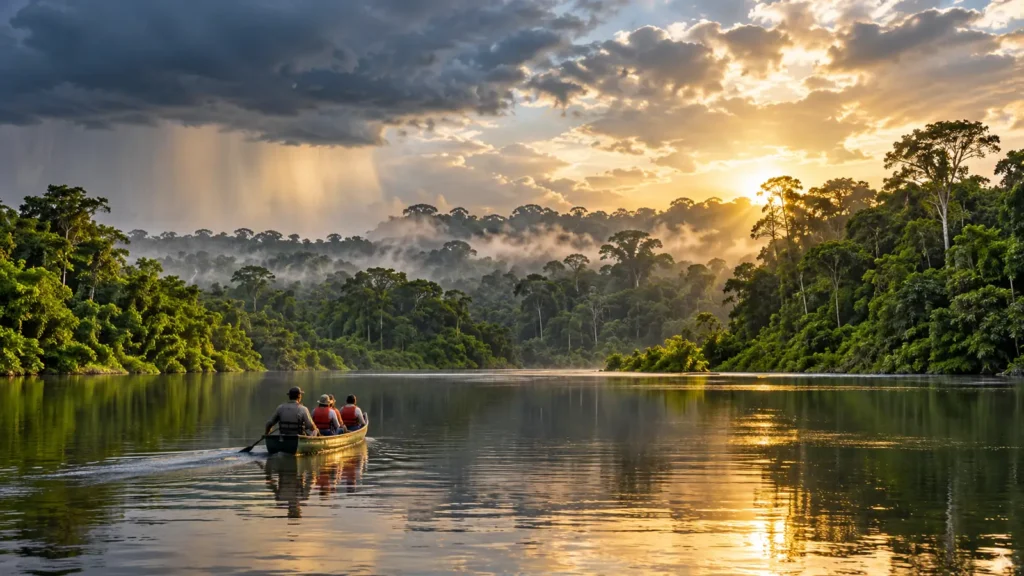
A productive day often begins before breakfast with a quiet boat ride or trail walk. The group listens for primates and birds while temperatures are lower, then pauses at fruiting trees, lake edges or a canopy viewpoint. Midday may be less active, but it provides time to review photographs, ask the guide about tracks and learn which species were heard rather than seen.
Late afternoon brings another observation window along water or forest edge. After dinner, a guided night walk changes the scale of attention: instead of scanning for large mammals, travelers examine leaves, bark and shallow pools for frogs, insects and reptiles. A single day can therefore cover several wildlife communities without chasing animals or leaving authorized routes.
Results vary enormously. One morning may bring several monkey groups and no otters; another may be quiet until a mixed flock moves through the canopy. Rain can shorten one activity while improving amphibian observations later. Keeping a simple field list of species seen, heard and identified by sign makes the trip richer than counting only large or famous animals.
Setting expectations before booking
Ask the operator which habitats the itinerary actually visits, how large the excursion groups are and whether activities include dawn departures, night walks or non-motorized lake travel. Request clarification when marketing language says an animal “can be seen.” That phrase should describe habitat potential, not a promise.
Also ask whether the itinerary enters a protected area, which authority manages it and whether an authorized guide or operator is required. Longer travel time does not automatically mean better wildlife, but moving away from busy access points can reduce disturbance. The strongest itinerary balances travel time with repeated, patient observation in suitable habitat.
Frequently asked questions
Will I see a jaguar in the Peruvian Amazon?
Probably not on a short lodge stay. Jaguars occur in the region but are elusive and wide-ranging. Choose a trip for the whole ecosystem, not a promised cat sighting.
Where can I see giant river otters?
Protected oxbow lakes in southern destinations such as Tambopata are important habitat. Even where a resident family is known, observation depends on timing, conditions and responsible distance.
Are pink river dolphins found near Iquitos?
Yes, river dolphins inhabit waterways in Loreto and are among the species associated with Pacaya Samiria routes. They surface briefly, so patient boat-based observation is useful.
Is wildlife better in the dry season?
Not universally. Drier trail conditions help some excursions, while higher water provides boat access into flooded forest. Each season changes access and animal distribution rather than turning wildlife on or off.
How many days are best for wildlife watching?
Three days can introduce several habitats, but four or more days provide extra dawns, night walks and flexibility if rain affects an excursion.
Can children join wildlife excursions?
Often yes, depending on age, lodge rules and activity. Families should confirm boat safety, walking distances, night-walk conditions and private-guide options before booking.
Editorial sources
Species, habitat and visitor-practice information was checked against the official SERNANP pages for Tambopata National Reserve and Pacaya Samiria National Reserve, together with the current Explora el Peru tour itineraries. Wildlife is free-ranging, and no sighting should be interpreted as guaranteed.